
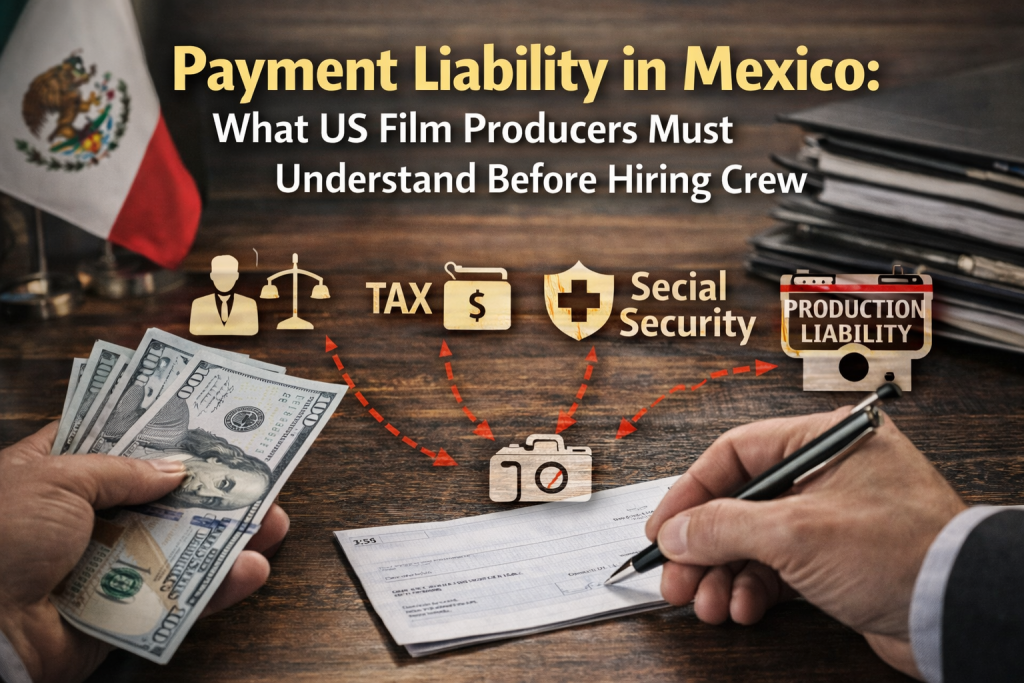
For US audiovisual producers, the greatest misunderstanding about Mexico is believing legal exposure begins when a dispute appears. In reality, it begins the moment a production starts paying people. Payment flows define responsibility, and under Mexico’s current regulatory environment, whoever controls the money can inherit obligations they never intended to assume.
This guide walks US producers through how Mexico turns payment structure into legal liability, where the trap doors are, and how to design payment architecture so that paying film crew in Mexico doesn’t leave you holding someone else’s tax bill long after wrap.
Why Payment Flows — Not Day Rates — Define Liability in Mexico
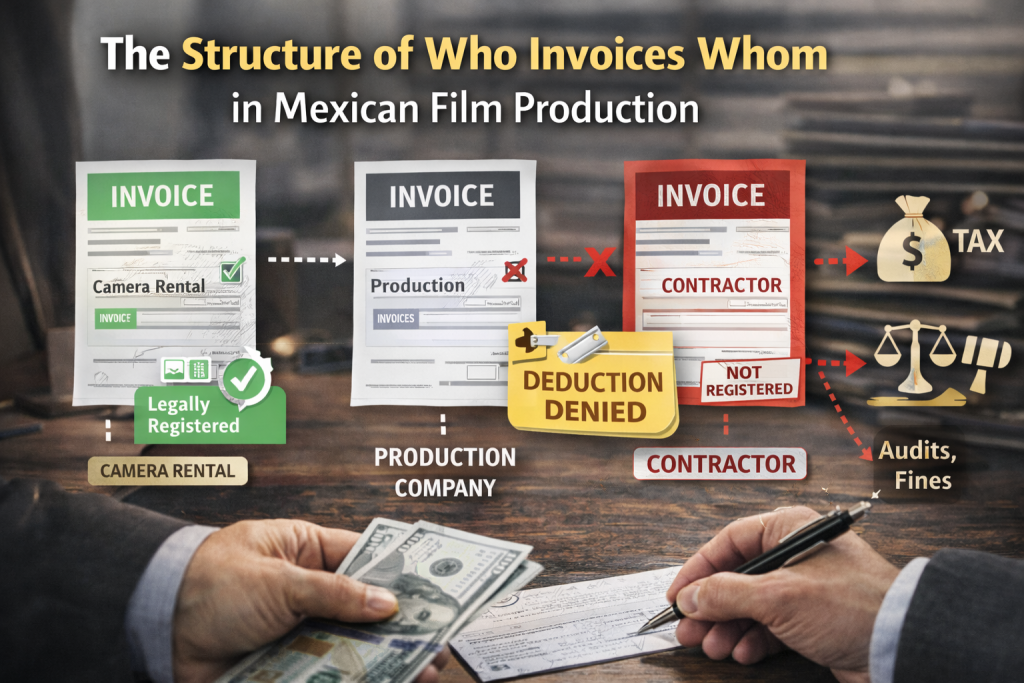
US studios are used to a world where negotiating the day rate and signing a contract closes the legal question. In Mexico that assumption is wrong. The structure of who invoices whom matters more than what was negotiated, because Mexico’s post-2021 labor reform and ongoing SAT enforcement attach responsibility to whoever paid — even if the contract said otherwise.
A production may believe it is hiring independent professionals through a local intermediary. But if that intermediary lacks the right registration, the production becomes the payer of record for purposes of Mexican labor and tax law, with retroactive consequences that surface during audits months after filming is complete. For the broader compliance context, see Mexico Film Production Compliance Guide for US Producers.
How Mexico’s Labor and Tax Rules Make Payers Responsible
Three regulatory pillars determine whether a payment is clean or contaminated:
REPSE: The Specialized-Services Registry You Can’t Skip
Since the 2021 subcontracting reform, any vendor providing specialized services to a production must hold a current REPSE (Registro de Prestadoras de Servicios Especializados) registration with STPS. Payments to a vendor without an active REPSE entry are not deductible for income tax, are not creditable for VAT, and can trigger joint liability for the vendor’s labor and tax debts. The registry is public and verifiable at repse.stps.gob.mx.
Joint Liability for Crew Payments
When a vendor is non-compliant, the hiring production becomes jointly and severally liable for that vendor’s social-security contributions, income-tax withholdings, and labor claims. This applies even when the vendor was contracted in good faith. The protection is process, not paperwork: continuous verification of the vendor’s IMSS enrollment, SAT standing, and REPSE registration throughout the engagement.
CFDI Invoicing and the SAT Audit Trail
Every payment to a Mexican vendor must be backed by a valid CFDI (Comprobante Fiscal Digital por Internet) issued by SAT. A CFDI with the wrong product/service code, missing payment-method node, or no corresponding payment receipt (complemento de pago) is treated as if the expense never existed for deductibility and VAT-credit purposes — even when the money clearly left your account.
Three Vendor Structures That Get US Productions in Trouble
In our experience supporting US productions, the same three payment-structure mistakes account for most of the avoidable liability we see:
- Single payroll vendor handling the entire crew. Reads cheap and clean on paper; in practice the arrangement is reclassifiable as illegal outsourcing of the production’s primary activity.
- Cash advances or wire transfers without CFDI. The money moved but the tax records didn’t — expense is non-deductible and VAT non-creditable.
- Foreign entity paying Mexican crew directly without a local production company. Triggers permanent-establishment risk and forces 0% VAT eligibility back to 16% retroactively.
Each of these mistakes is invisible at the time of payment. They surface months or years later in an SAT or IMSS audit, when the production no longer has leverage with vendors who may have closed or disappeared. For how this dovetails with inspections, see Filming in Mexico: Legal Requirements for Foreign Productions.
Designing Payment Architecture Before the First Transfer
Productions that avoid these outcomes are not the ones that spend more — they’re the ones that map their legal architecture before a single peso moves. The work is mechanical and not particularly expensive, but it must happen before contracts are signed.
Map Every Payment Before You Wire Anything
Build a single payment matrix that lists every line item against the entity that will invoice it, the CFDI code that will be used, and whether the engagement triggers specialized-services rules. Productions that skip this step routinely discover during post-production that 20-30% of their spend can’t be deducted.
Verify REPSE and IMSS Status Weekly
A vendor’s REPSE registration can expire mid-shoot. Their IMSS enrollment for a specific worker can lapse if a contribution is missed. A weekly verification cadence — documented in writing — is the cheapest insurance you can buy against joint liability.
Document Supervision and Direction
If your production is directing the day-to-day work of a vendor’s personnel, you may be the de facto employer in the eyes of Mexican labor authorities, regardless of contract language. Document the supervision boundary explicitly. When the production direction is operationally necessary, route those workers through your own Mexican production entity rather than through a generic services vendor.
Treat Legal Architecture as Part of Production Design
Mexico remains one of the most capable production environments available to US producers, but only when its legal mechanics are respected with the same attention given to scheduling, financing, or insurance. The difference between a smooth shoot and a costly aftermath is rarely creative — it’s structural.
When payment flows are designed correctly, the production controls its risk, protects its budget, and turns Mexico into a reliable partner. The 0% VAT exemption and the 30% federal tax credit introduced by the 2026 decree are both available — but only to productions whose payment architecture is built to capture them.
Conclusion: Predictable Productions Start with Predictable Payments
Mexico’s regulatory system is not designed to obstruct filmmaking. It exists to ensure that the economic activity around production respects labor protections and fiscal transparency. When producers understand this and align their payment structures accordingly, Mexico becomes not only a creative destination but a predictable, secure environment for international production.
Before you sign your next Mexico vendor agreement, have ANFEPA review the payment architecture — a one-page payment map is the cheapest risk-management tool available.
FAQ: Paying Film Crew in Mexico
Can a US production company pay Mexican crew directly?
Generally no. Direct foreign payment of Mexican crew can trigger permanent-establishment exposure and breaks the 0% VAT chain. The accepted structure is to pay through a Mexican production entity (or a SAT-registered services vendor) that issues CFDI invoices.
What is REPSE and why does it matter for film payments?
REPSE is STPS’s registry for specialized-services providers. Payments to a vendor without an active REPSE entry are non-deductible, non-creditable for VAT, and expose the production to joint liability.
What is joint liability for film productions in Mexico?
If a vendor in your payment chain is non-compliant (missing IMSS enrollment, expired REPSE, missing CFDI), the hiring production becomes jointly and severally responsible for that vendor’s labor and tax debts — even after wrap.
Do I need a CFDI for every Mexican production payment?
Yes. Any payment intended to be deductible or VAT-creditable must be backed by a valid CFDI with correct product/service code and payment receipt complement.
How can a US producer protect themselves from payment liability in Mexico?
Map every line item to a compliant invoicing entity before contracting, verify REPSE/IMSS/SAT status weekly during production, document supervision boundaries, and route operationally-directed personnel through the production’s own Mexican entity.

