
For US audiovisual producers, budgets are usually protected through insurance, completion bonds, and detailed scheduling. Yet one of the most significant exposures when filming in Mexico sits outside all of those protections: regulatory verification. A labor or tax inspection during production doesn’t behave like a later audit. It interrupts the shoot immediately, and a single unanswered requirement can justify a temporary suspension of activities.
This guide walks US producers through how filming in Mexico inspections actually work, what triggers them, and how to keep a shoot inspection-ready so SAT, STPS, or IMSS arriving on set becomes a routine administrative interaction instead of a production delay.
How Mexican Labor and Tax Inspections Actually Work
Mexican authorities don’t only review contracts after a conflict; they may review a production while it is operating. Three agencies can show up on set or at the production office:
- STPS (Secretaría del Trabajo y Previsión Social) — labor inspections, REPSE compliance, working conditions.
- SAT (Servicio de Administración Tributaria) — tax compliance, CFDI invoicing, VAT credits, withholding.
- IMSS (Instituto Mexicano del Seguro Social) — social-security enrollment and contributions for crew.
Each agency can act independently, and any of them can pause work until a documented response is provided. Foreign productions often discover during their first inspection that the compliance burden they thought was the vendor’s is, legally, their own.
Why Inspections Stop Productions (Not Just Fine Them)
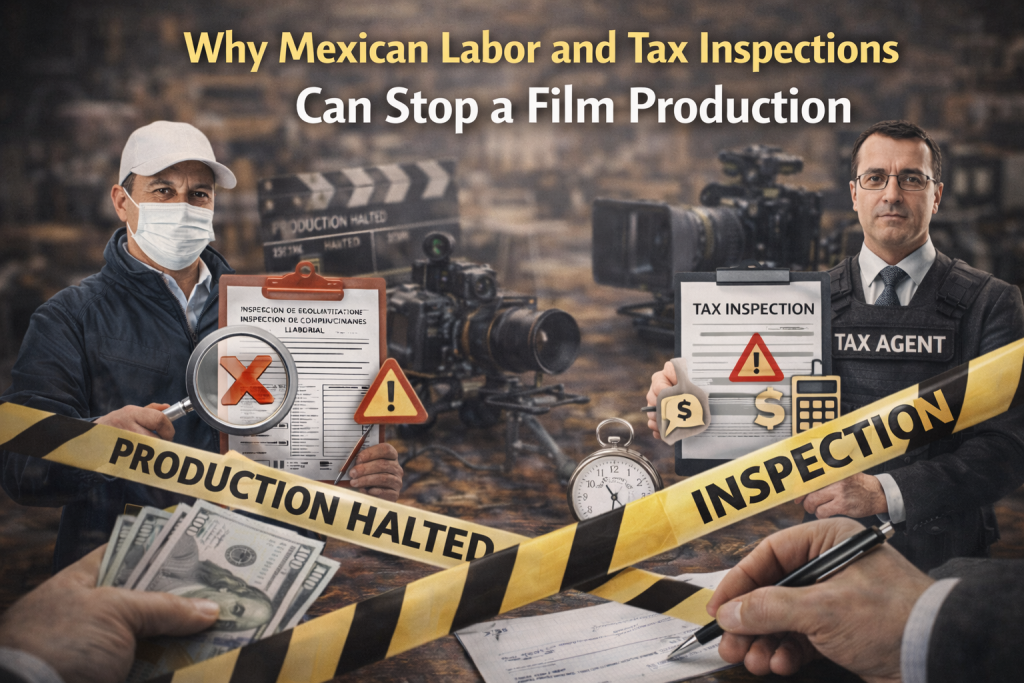
US producers are used to a world where regulatory issues become fines, fines become legal disputes, and disputes are managed over months. Mexico’s inspection regime moves faster. An inspector who finds an unregistered specialized-services vendor on set, or a worker without verifiable IMSS enrollment, can issue a same-day suspension order while the issue is resolved.
The financial damage is rarely the fine itself — it’s the lost shooting day, the displaced crew, and the cascading impact on the schedule. Productions that have not pre-mapped their compliance architecture lose creative time negotiating with inspectors instead of shooting.
What Triggers an Inspection on a Foreign Production
Inspections are not always triggered by wrongdoing. They are frequently routine, random, or the consequence of a third party’s filings. The three most common patterns we see:
Third-Party Vendor Reporting Failures
If a provider’s payroll reporting, social-security contributions, or service registration is inconsistent, authorities don’t isolate the issue to that provider alone. They evaluate the entire production structure and ask the production to demonstrate due diligence in selecting and supervising its specialized-services vendors. For how vendor selection affects payment exposure specifically, see Paying Film Crew in Mexico: A Guide for US Producers.
Subcontracting Reform (Post-2021) Red Flags
A crew that looks like it has been outsourced through a single payroll vendor — especially one without an active REPSE registration — is the single most common inspection trigger we see. The post-2021 subcontracting reform made this arrangement illegal for activities that fall within the contracting company’s primary business. Full context in Mexico Film Production Compliance Guide for US Producers.
CFDI / SAT Mismatches in Production Spend
SAT’s electronic invoicing system flags inconsistencies automatically: a payment recorded by one party with no matching CFDI on the other side, product/service codes that don’t match the expense category, or a 0% VAT classification claimed without supporting documentation. Each mismatch can become an inspection ticket.
Filming in Mexico Legal Requirements: Pre-Shoot Checklist
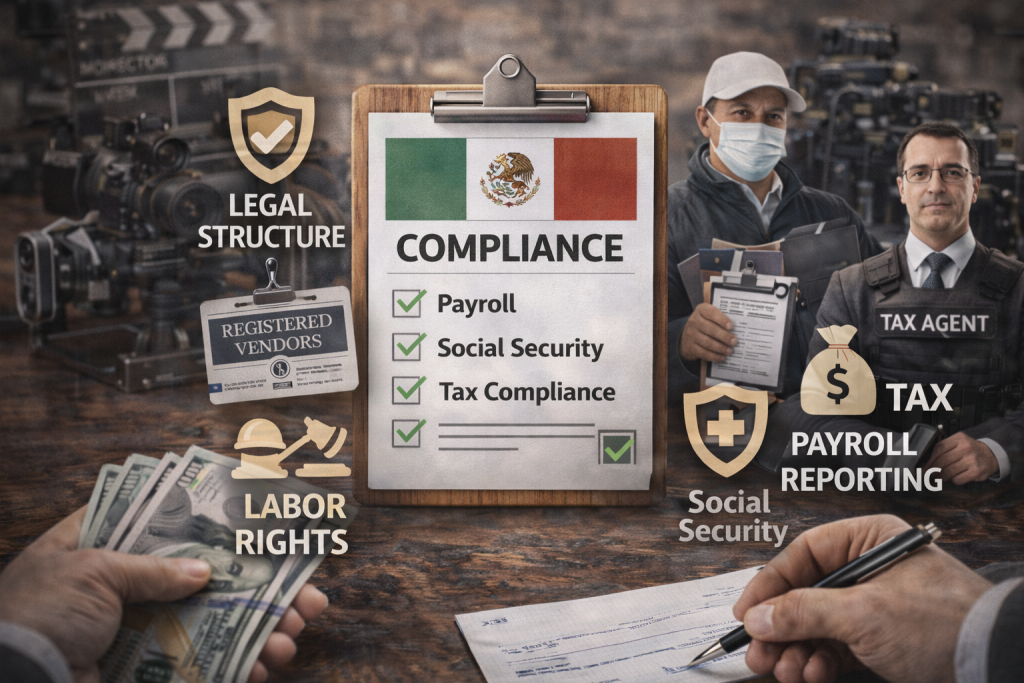
Before you start filming in Mexico, your production should be able to produce documentation for each of the following on demand. Treat this as a Day 0 readiness list, not a wrap-week catch-up:
- Filming permits — federal, state, and municipal, depending on locations.
- A compliant payroll structure — routed through a Mexican production entity with valid SAT registration.
- Registered vendors and service providers — current REPSE entries for any specialized service.
- Tax compliance strategy — IVA (VAT) classification, ISR (income tax) withholding, CFDI issuance.
- Talent agreements aligned with Mexican law — including image rights and union rules where applicable.
- Verifiable documentation for inspections — a live compliance folder accessible from set.
Productions that meet these requirements can continue shooting even when an inspector is on site. Productions that can’t demonstrate compliance in real time are exposed to operational delays. See Mexico Film Tax Incentives 2026: 30% Credit and 0% VAT for International Producers for how the same documentation also unlocks the federal tax credit.

How to Stay Inspection-Ready During Production
Maintain a Live Compliance Folder
A single shared folder — accessible from set on any phone — with every vendor’s REPSE certificate, IMSS enrollment confirmation, SAT standing letter, and crew contract. When an inspector asks, the answer is one screen away.
Run Weekly Vendor Verification
REPSE registrations can expire mid-shoot. IMSS enrollments can lapse if a contribution is missed. A weekly written verification cadence converts joint-liability risk into documented due diligence.
Designate an On-Set Compliance Point of Contact
One person on the production team whose job is to receive inspectors, produce the compliance folder, and route any unresolved item to legal counsel. Productions without a designated contact lose hours having inspectors talk to whoever happens to be nearest the trailer.
What Happens When Inspectors Arrive
Producers who prepare for this reality operate differently. They maintain verifiable documentation, monitor vendor obligations continuously, and structure agreements so responsibility is clearly allocated and demonstrable. When an authority appears, the production doesn’t negotiate under pressure — it shows its compliance record and continues working. This converts a potentially disruptive event into a routine administrative interaction and preserves both the shooting schedule and the budget.

Conclusion: Predictability Is What Studios Actually Buy
Mexico offers extraordinary production value, but it also expects operational seriousness. A production prepared for verification operates calmly because its legal structure is as organized as its call sheet. When compliance is designed as part of production management — not treated as an afterthought — the country becomes predictable, and predictability is what studios and financiers are ultimately buying when they choose where to shoot.
Planning a shoot in Mexico in the next 12 months? Contact ANFEPA for a pre-production inspection-readiness review before you lock dates.
FAQ: Filming in Mexico Inspections
Can a Mexican inspector actually stop a film production?
Yes. STPS, SAT, and IMSS inspectors can issue same-day suspension orders if they find unregistered specialized-services vendors, missing IMSS enrollment for crew, or material CFDI inconsistencies. The shoot pauses until the documented response is accepted.
What documents should I have on set during a film production in Mexico?
Active REPSE certificates for all specialized-services vendors, current IMSS enrollment for crew, SAT standing letters for the production entity and primary vendors, CFDI records for the shoot week, and federal/state/municipal filming permits.
How often are foreign productions inspected in Mexico?
Inspections are often routine or random rather than triggered by wrongdoing. Higher-profile productions, productions with high local spend, and productions that use a single payroll vendor are all more likely to be inspected.
What is REPSE and why does it matter during an inspection?
REPSE is the STPS registry for specialized-services providers. An inspector will check every visible vendor against the live REPSE database. A vendor without an active entry is one of the fastest paths to a suspension order.
Are foreign productions treated differently in inspections?
No — the requirements are the same. But foreign productions tend to lean more heavily on local vendors for compliance, which is why an issue with a third-party vendor frequently becomes an inspection of the production itself.

